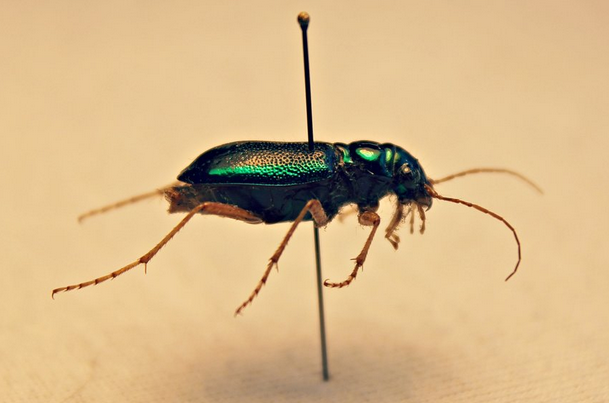
 Pins, politics and patterns I've been reading a totally brilliant book about beetles and loved this wonderful insight.
Collecting insects (and of course everything else) has been part of our most primal natures, but it was only in the c18th that preserving and mounting specimens really became more possible, owing to a rather unlikely industry: pin-making. In 'The Wealth of the Nations', Adam Smith famously referred to pin-making as an example of efficiency that could be achieved by the division of labour, and by the the mid 1700s London, Gloucester and Bristol had become the largest pin-making centres of the world. Mostly used by the garment industry, pins were adopted quickly by the entomologists of the day as a way to attach their specimens. Up to this point, collectors had had varying degrees of success with maintaining their hoards - some even resorting to squashing specimens between the pages of a book. Good for flowers maybe but... It took a little while for mass-production of pins to allow for the manufacture of those made specifically for entomological use, but finally by the 1800s there was way to store, identify and arrange specimens more systematically. Those beautiful aesthetics around pinned specimens arranged in neat rows and patterns were born too. I love that early instructions from 1690 courtesy of one James Petiver (from his single folio sheet entitled: "Brief Directions for the Easie Making and Preserving Collections of all Natural Curiostities"), suggested that insects should be preserved by thrusting a pin through their body and sticking them to one's hat, until one has the opportunity to get a board and pin them to the wall of one's cabin, or the inside of a 'deal' box, so that would avoid being crushed. More soon (ish), T |
 RSS Feed
